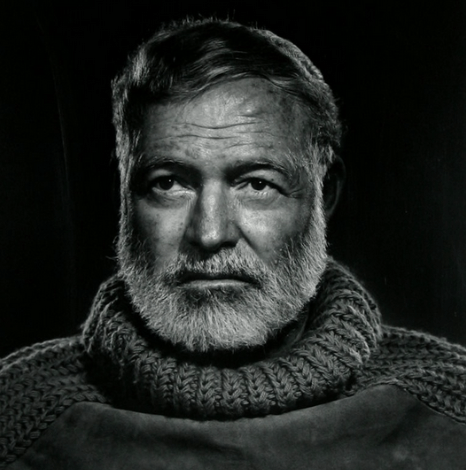
A Dive into Subtext and Minimalism
Ernest Hemingway, renowned for his distinct literary style, introduced the Iceberg Theory, also branded as the theory of omission. Born from his experiences as a journalist during World War I and his desire to convey more with less, Hemingway’s theory focused on presenting only the tip of the narrative “iceberg,” leaving readers to infer the submerged complexities beneath.
In one of his most beloved short stories titled “The Old Man and the Sea,” Ernest Hemingway employs the iceberg theory, also known as the “iceberg principle” or “theory of omission.” He presents a minimalistic narrative style, revealing only the surface details while leaving underlying themes and emotions to be inferred by the reader. Through sparse dialogue and description, Hemingway hints at the depths of the characters’ experiences and struggles. For instance, the relationship between the old man, Santiago, and the boy, Manolin, is portrayed through their actions and subtle exchanges, allowing readers to deduce the profound bond they share. The novel’s emphasis on Santiago’s inner thoughts, his resilience, and the broader symbolism of the struggle between man and nature all exemplify Hemingway’s mastery of the iceberg theory, where so much more lies beneath the surface.
Ernest Hemingway didn’t explicitly label his approach as the “Iceberg Theory,” but he did convey the essence of this concept in various statements. He advocated for omitting unnecessary details and allowing readers to infer deeper meanings. One of his notable quotes that encapsulates this idea is:
“If a writer of prose knows enough about what he is writing about, he may omit things that he knows and the reader, if the writer is writing truly enough, will have a feeling of those things as strongly as though the writer had stated them. The dignity of movement of an iceberg is due to only one-eighth of it being above water.”
This quote reflects Hemingway’s philosophy of letting readers sense the submerged complexities without explicit exposition. While he didn’t explicitly outline the “Iceberg Theory,” his approach to writing and his emphasis on the economy of words and subtext have become synonymous with this concept in literary discussions. Less is more. This is something that I as an author struggle with and need to be conscious of when I write prose. The more I write, the better I am at attaining Hemmingway’s standards, or at least strive to reach.
Implementing the Iceberg Theory in writing offers several advantages to authors. Firstly, it engages readers by inviting them to actively participate in deciphering the underlying meanings, fostering a more immersive experience. Secondly, it allows for open interpretation, enabling a broader audience to connect with the narrative on a personal level. Furthermore, this approach lends itself to brevity, making it a powerful tool in short stories or concise narratives. Lastly, the theory demands meticulous crafting, honing an author’s skills in conveying profound themes within constrained word limits.
In conclusion, the Iceberg Theory epitomizes Hemingway’s belief in the potency of understatement. By skillfully revealing a fraction of the story’s depth and leaving the rest submerged, he paved the way for a writing style that encourages readers to become active participants in the narrative. Authors who adopt this approach harness its ability to captivate, engage, and challenge readers while honing their own craft to convey more with less. Hemingway’s legacy lives on through his Iceberg Theory, a testament to the enduring power of subtext and minimalism in literature.




You must be logged in to post a comment.